The Quran stands not merely as a text but as the miraculous word of God, revealed to the Prophet Muhammad through the mediation of the Angel Gabriel. This process of divine descent established a fundamental precedent: the necessity of accurate, guarded oral transmission that would echo through centuries.
The revelation itself emphasizes the critical nature of this oral delivery. God Almighty says:
وَإِنَّهُ لَتَنْزِيلُ رَبِّ الْعَالَمِينَ (۱۹۲) نَزَلَ بِهِ الرُّوحُ الأَمِينُ (۱۹۳) عَلَى قَلْبِكَ لِتَكُونَ مِنَ الْمُنْذِرِينَ (١٩٤)
"And truly, this (the Qur'an) is a revelation from the Lord of the 'Alamin (mankind, jinns and all that exists). Which the trustworthy Ruh [Jibril (Gabriel)] has brought down; Upon your heart (O Muhammad) that you may be (one) of the warners."
(Surah Asy-Syuara': 192-194)
This passage suggests that wahyu (revelation) is not simply a written script but a recitation transmitted directly and preserved through a precise process of reception. Furthermore, God affirms the guarantee of the Quran's preservation until the end of time in His saying:
إِنَّا نَحْنُ نَزَّلْنَا الذِّكْرَ وَإِنَّا لَهُ لَحَفِظُونَ
"Verily We: It is We Who have sent down the Dhikr (i.e. the Qur'an) and surely, We will guard it (from corruption)."
(Surah Al-Hijr: 9)
This divine assurance is inextricably linked to the legal (syar'i) causes established by God, primarily through the scholarly chain of transmission (sanad) and correct pedagogical methods. From the perspective of Quran memorization (tahfizh) education, this preservation encompasses not only meanings and laws but also the wording, letters, and specific methods of pronunciation. Reading the Quran correctly is an act of worship, just as understanding and practicing it is.
This point is emphasized by Imam As-Suyuthi in Al-Itqan fi 'Ulumil Qur'an:
ولا شك أن الأمة كما هم متعبدون بفهم معاني القرآن وإقامة حدوده، هم متعبدون بتصحيح ألفاظه وإقامة حروفه على الصفة المتلقاة عن أئمة القراء المتصلة بالحضرة النبوي
"There is no doubt that the Ummah, just as they worship by understanding the meanings of the Quran and establishing its limits, they also worship by correcting its expressions and establishing its letters according to the attribute received from the Imams of recitation whose chain of transmission connects to the Prophetic presence."
This statement underscores the urgency of talaqqi—the process of learning directly from a teacher who possesses scholarly authority, precision in reading, and a clear chain of transmission. Without talaqqi, precision in the articulation points of letters (makharijul huruf) and their characteristics is difficult to achieve accurately.
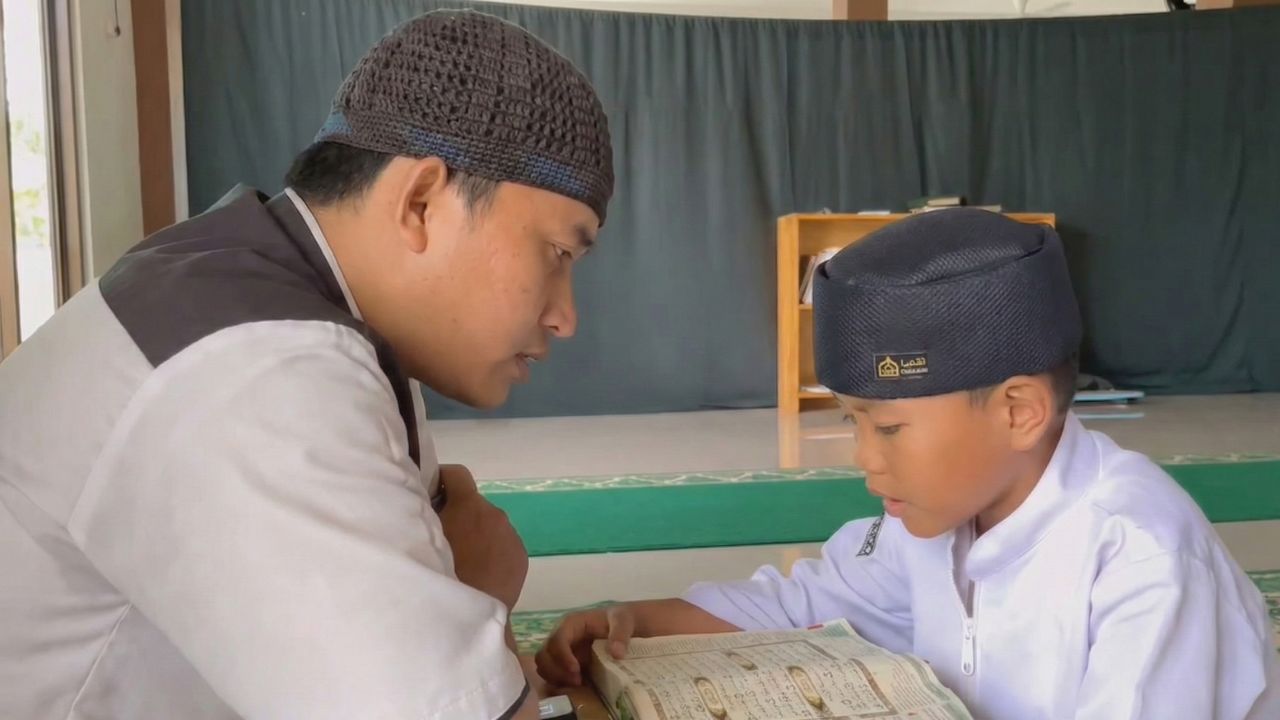
The talaqqi method, also known as musyafahah (oral transmission), is a method of Quranic learning that has been practiced since the early generations of Islam. Talaqqi involves direct interaction between teacher and student, whether by the student listening to the teacher's reading or reading in front of the teacher to be subsequently corrected. This practice has proven effective in maintaining the accuracy of reading and the continuity of the scientific sanad.
Imam As-Suyuthi asserts that reading in front of a teacher is the method practiced by the predecessors and the successors. Imam As-Suyuthi said:
وأما القراءة على الشيخ فهي المستعملة سلفا وخلفا
"As for reading in front of a teacher, that is the method used by the predecessors and the successors."
Among the evidences for the permissibility of reading in front of a teacher is that the Prophet used to make Gabriel hear (recite to him) the Quran every month of Ramadan each year. In the Sahihain (Bukhari and Muslim), from Ibn 'Abbas radhiyallahu 'anhuma, he said:
كَانَ النَّبِيُّ - صلى الله عليه وسلم - أَجْوَدَ النَّاسِ ، وَأَجْوَدُ مَا يَكُونُ فِي رَمَضَانَ ، حِينَ يَلْقَاهُ جِبْرِيلُ ، وَكَانَ جِبْرِيلُ - عَلَيْهِ السَّلَامُ يَلْقَاهُ فِي كُلِّ لَيْلَةٍ مِنْ رَمَضَانَ ، فَيُدَارِسُهُ الْقُرْآنَ فَلَرَسُولُ اللَّهِ - صلى الله عليه وسلم - أَجْوَدُ بِالْخَيْرِ مِنَ الرِّيحِ الْمُرْسَلَةِ
"The Prophet shallallahu 'alaihi wa sallam was the most generous of people. His spirit in giving was even more ardent during the month of Ramadan when Gabriel met him. Gabriel met him every night in Ramadan. Gabriel taught the Quran at that time. And the Messenger shallallahu 'alaihi wa sallam was the most enthusiastic in doing good, like the blowing wind."
(Sahih al-Bukhari: 3554 and Sahih Muslim: 2307)
Similarly, God commanded His Prophet to receive the reading from Gabriel by listening, as in His saying:
فَإِذَا قَرَأْنَاهُ فَاتَّبِعْ قُرْآنَهُ
"And when We have recited it to you [O Muhammad through Jibril (Gabriel)], then follow you its (the Qur'an's) recital."
(Surah Al-Qiyamah: 18)
Additionally, the Messenger explicitly commanded his people to take the Quran from certain Companions known for their precision and knowledge in recitation (qira'ah). The Messenger said:
خذوا القرآن من أربعة من عبد الله بن مسعود، فبدأ به وسالم مولى أبي حذيفة، ومعاذ بن جبل، وأبي بن كعب
"Take the Quran from four people: from Abdullah bin Mas'ud — he mentioned him first — Salim the freed slave of Abu Hudzaifah, Mu'adz bin Jabal, and Ubay bin Ka'ab."
(Sahih al-Bukhari: 3808)
In the scope of modern Quran memorization education, the principle of talaqqi remains relevant even though learning tools have developed. Recordings of readings by proficient (mutqin) reciters may serve as a helping tool, especially when access to teachers is limited. However, such recordings cannot fully replace direct talaqqi; rather, they function as a supplement. There is a jurisprudential maxim:
الميسور لا يسقط بالمعسور
"That which is easily done shall not be abandoned because of that which is difficult."
There is a story recorded by Imam As-Suyuthi in the book Al-Itqan regarding Imam Ibn al-Jazari. He mentioned:
ويحكى أن الشيخ شمس الدين بن الجزري لما قدم القاهرة وازدحمت عليه الخلق لم يتسع وقته لقراءة الجميع، فكان يقرأ عليهم الآية ثم يعيدونها عليه دفعة واحدة
"It is told that when Shaykh Shamsuddin Ibn al-Jazari came to Cairo and people crowded around him, his time was not sufficient to read the Quran to everyone one by one. So he would read a verse to them, then they would repeat it back to him all at once together."
This story teaches that the talaqqi method is not merely a rigid hereditary method. More than that, it is a teaching system proven capable of adapting to real conditions in the field without sacrificing accuracy and the quality of knowledge transmission. The flexibility shown by Imam Ibn al-Jazari, while holding fast to the principles of listening and direct correction by a teacher, proves that the core of talaqqi is maintaining a live educational interaction between teacher and student, not merely the physical form of their meeting.
Therefore, the commitment to maintaining, developing, and strengthening the position of talaqqi in the Quran memorization curriculum is a strategic step. This step is valuable not only as an academic effort to guarantee the authenticity of the reading but also as a trust to ensure the scientific sanad of the Quran remains connected to the next generation in a way whose validity has been tested throughout history.

The teacher transmits the recitation to his student via talaqqi: Tahfizh Makkah
Advantages and disadvantages of the talaqqi method in Quran memorization learning
The talaqqi method is one of the most classic methods possessing a strong sanad in Quranic learning, particularly in the teaching of reading (tahsin) and memorization (tahfizh). Etymologically, talaqqi comes from the Arabic "talaqqā-yatalaqqā" which means "to receive directly." In the realm of Quranic education, talaqqi is understood as a learning process where the student receives the Quranic reading directly from a teacher by listening, imitating, and being corrected directly. This method has been practiced since the time of the Messenger when he received revelation from the Angel Gabriel and then recited it to the Companions, which was subsequently inherited from generation to generation until the current Muslim generation. This practice becomes a strong foundation for the validity of talaqqi as an authentic method of Quranic learning whose originality is guarded.
From the perspective of educators in Quran memorization schools, talaqqi is proven to be very effective in introducing hijaiyah letters, habituating articulation points (makharijul huruf), and applying tajweed rules correctly. Direct interaction between the teacher and student allows for rapid and accurate feedback, so that reading errors can be immediately corrected before they take root. This aligns with the affirmation of the scholars of recitation that the correctness of Quranic reading is not sufficient if learned only through text, but must go through oral transmission from a proficient (mutqin) teacher.
المقرى فهو العالم بالقراءات التي رواها مشافهة بالتلقي عن أهلها إلى أن يبلغ النبي صلى الله عليه وسلم.
"The al-muqri' (expert in recitation) is a scholar who masters the recitations, who narrates them orally through the process of talaqqi and musyafahah from the experts until the sanad connects to the Prophet Muhammad."
(Kitab Fatwa Yas'alūnaka, 13: 20)
The successful application of the talaqqi method is strongly determined by several main factors:
- First, the quality of reading and the scholarly capacity of the guiding teacher. The teacher must not only possess strong memorization (hafizh) but also a capable mastery of the science of qira'ah and tajweed as well as possessing a reading sanad, because the teacher acts as the reading model that will be imitated by the student.
- Second, the teacher's mastery of the talaqqi teaching method, which encompasses the ability to provide precise corrections, delivery that is easy to understand, and the adjustment of approaches to the individual characteristics of students.
- Third, the diligence and discipline of the student in understanding the material, carrying out repeated practice (muraja'ah), and maintaining the continuity of deposit/recitation (tasmi') in an orderly manner. The synergy of these three factors forms an ideal learning ecosystem for the preservation of memorization.
The talaqqi method offers a number of substantive advantages that make it relevant even in the modern era:
- First, this method cultivates emotional attachment between the educator and the student, creating a harmonious and respectful relationship, which is an important value in Islamic education.
- Second, the educator can directly guide and correct the student's reading, so that errors in articulation (makhraj) and tajweed do not drag on.
- Third, the student can directly see the movement of the teacher's lips in pronouncing hijaiyah letters, which is very helpful in learning the Quran.
- Fourth, talaqqi functions as an effective motivational tool, especially for those whose motivation to memorize is still lacking.
- Fifth, this method prepares students to memorize independently with a reading that is already relatively correct, so that the memorization formed is stronger and its quality is maintained.
However, the talaqqi method also possesses a number of limitations that need to be scrutinized by managers of tahfizh schools, including:
- First, talaqqi is less effective if applied classically in a class with a large number of students, due to its individual nature.
- Second, this method is relatively inefficient in terms of time, because it requires a long duration in the talaqqi process.
- Third, students with low cognitive ability or slow grasp tend to require a longer time to complete memorization, thus requiring extra patience from the educator.
- Fourth, some children easily feel bored, especially when having to wait for their turn to deposit recitation, particularly if there are differences in memorization speed between students.
Thus, the talaqqi method remains a superior method in Quran memorization learning, especially in maintaining the quality of reading and the scientific sanad. However, this method needs to be managed wisely and, if necessary, combined with other supporting methods so that its weaknesses can be minimized without reducing its essence and priority.